


 (
(










 Login
Login Cart
CartTian Tai 0.5 kg
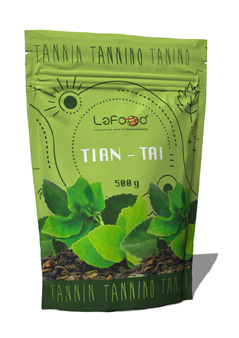
TIAN TAI
CATECHINIC TANNIN EXTRACTED FROM GREEN TEA LEAVES
DESCRIPTION
Green tea is made exclusively from the leaves of Camellia sinensis (or Thea chinensis), whose cultivation originated in China by Buddhist monks, who first cultivated variety, drying tea around their temple on Mount T'ian-t'ai (or "heavenly-tai"). The legend says that in the 805 A.D. Saicho, a Japanese monk visiting the T'ian-t'ai, fell in love with this tea and brought the plant to Japan.
Lafood®Tian Tai is a catechinic tannin from extraction and subsequent purification obtained from the leaves of green tea. The first step of extraction involves the use of warm water, to remove the chlorophyll and the first soluble substances. Subsequently the intermediate is filtered and concentrated prior to purification to cut out moisture or sugar. The final stage of purification takes place in chemical fractionation which selects the molecular weights of the polyphenols, concentrating those with greater reactivity. The final product is concentrated with the addition of hot water to remove residual alcohol and finally atomized in specific installations.
TECHNOLOGICAL APPLICATIONS
Lafood®Tian Tai is chemically is composed of very low molecular weight polyphenols proantocianidini variously esterified with gallic acid. Lafood®Tian Tai shows ample technological advantages, as it combines antioxidant properties and reactivity of proantocianidic (such as tannins and catechins) with those of being an antioxidant and stabilizer (such as gall tannins and tara), making it versatile and effective.
RED WINES
The condensed tannins are normally used in the stabilization of red wines, for the early stages of fermentation, racking and fixing. Due to its antioxidant and reactivity properties, Lafood®Tian Tai is particularly suitable for red wines with high color instability, or in areas of excessive polyphenol maturation grapes, because it results in the contraction of stable polyphenols and prevents the formation of color deviations.
The effectiveness of Lafood®Tian Tai is demonstrated in both fermentation and aging in micro-oxygenation.
WHITE AND ROSE WINES
In general the use of proantocianidic tannins on white wines requires special attention because of the possible transformation of molecules of a brown color in the presence of combined or free red radicals.
The use of Lafood®Tian Tai, however, does not change the color and thanks to its exceptional antioxidant properties prevents browning.
The use of Lafood®Tian Tai is possible:
-
In the early stages of fermentation to reduce the need of SO₂;
-
Before the first racking, so as to release the greener compounds from the wine and to optimize the mouthfeel, increasing the typical notes of each grape variety;
-
Before bottling, to improve the taste and refinement of the wine;
-
During aging, to enhance the fruity and floral notes that during the wine making have narrowed.
DOSES ANDINSTRUCTIONS FOR USE
RED WINES
To avoid the precipitation of tannin-TIAN TAI due to unstable proteins of wine, we recommend its use after gallic or ellagic tannins.
Fermentation in the recommended doses varies from 5 to 20 g/hl, depending on the concentration of anthocyanins.
In micro-oxygenation is recommended the addition of 5-10 g/hl before the the begining of process
WHITE WINES
During fermentation we recommend the use of 5-10 g/hl from the first day. By determining the free SO2 is possible restrict its use up to 25-30%.
After clarification and / or before bottling you can add 1-3 g/hl. Pre disperse the product in water in 1:2 ratio.
PACKAGING
STORAGE
500 g bags.
Store the product in cool and dry place.