


 (
(










 Login
Login Cart
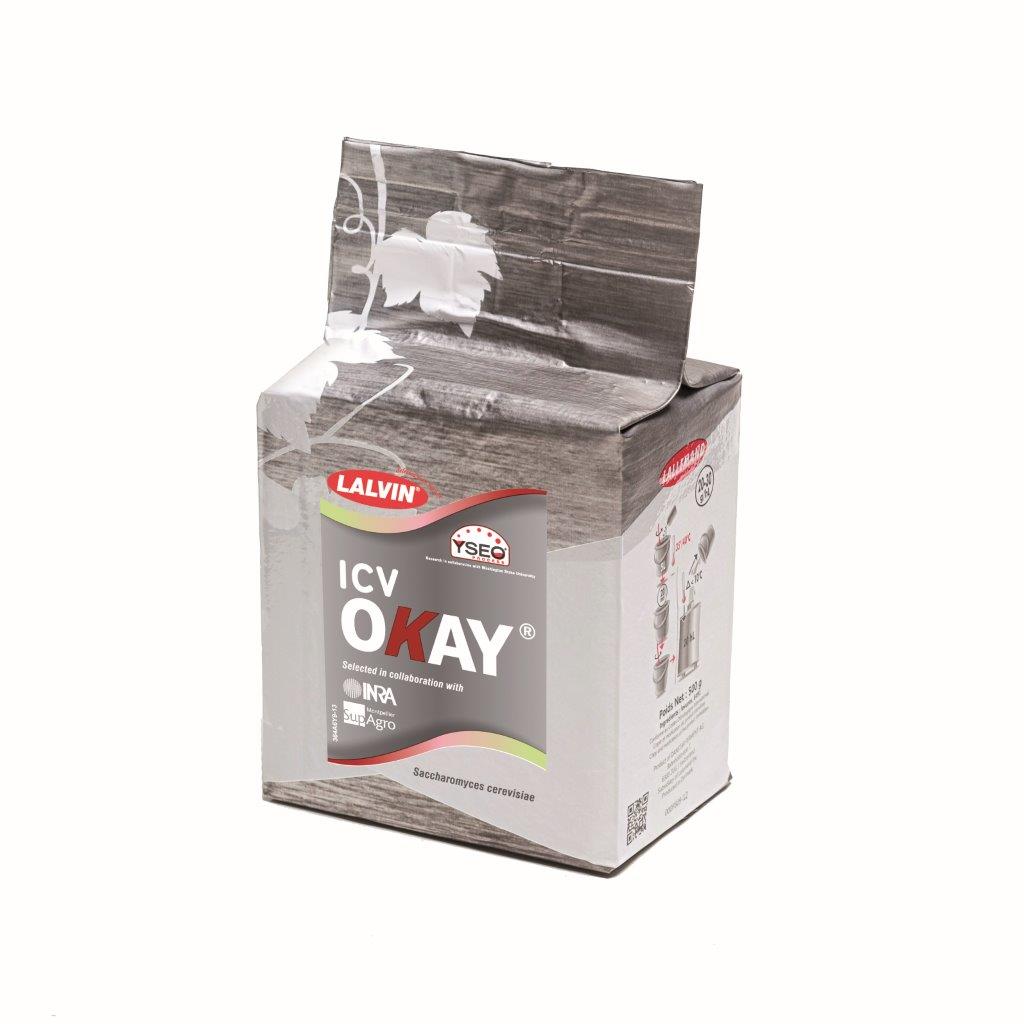
CartLALVIN ICV OKAY (YSEO) 0,5 kg
item(s) added to your cart
Cart total
ORIGIN AND APPLICATION
For young fresh and aromatic rose, white and red wines. Lalvin ICV OKAY® offers fermentation security whilst producing very low levels of acetaldehyde,
H2S and SO2.
The development of Lalvin ICV OKAY® was associated with a PhD related to the identification of a new mechanism responsible for the control of SO2 and H2S
production by wine yeast . A genetic study identified the molecular basis of these properties. Using marker-assisted selection techniques, Lallemand and ICV have selected, with the collaboration of INRA and Sup’ Agro Montpellier, Lalvin ICV OKAY®.
Lalvin ICV OKAY® exhibits a special ability to produce very low levels of H2S and SO2.
Moreover, the low acetaldehyde production of Lalvin ICV OKAY® will be a good asset to stabilize most wines with moderate SO2 levels. This yeast also offers fermentation security, completing fermentation in a large range of fermentation conditions. Tends to contribute good fruit intensity.
MICROBIAL AND OENOLOGICAL PROPERTIES
• Recommended for white, rose and red wine production.
• Saccharomyces cerevisiae
• Alcohol tolerance to 16% v/v *subject to fermentation conditions.
• Temperature tolerance 12°-30°C (54-86°F)
• Low relative nitrogen demand.
• Short lag phase with steady fermentation kinetics.
• Very low potential for SO2 production.
• Very low acetaldehyde production.
• Very low H2S production.
• Competitive factor active.
• Very malolactic-bacteria compatible
• Low foam producer.
FURTHER READING (Please request this booklet from your Lallemand representative).
Lallemand Winemaking Update – Number 1 2008: ‘The YSEO® Process’ Evaluation of the YSEO® Process to prepare dried winemaking yeast – Summary of a study done by Washington State University and Lallemand.
Lallemand FOCUS paper : Yeast options for fruit wine and cider making.
INSTRUCTION FOR USE
Dosage Rate:
• 25g/hL (2lb/1000gal) of Active Dried Yeast (this will provide an initial cell population of approximately 5 x10⁶ viable cells/mL)
• 30g/hL (2.4lb/1000gal) of Go-Ferm Protect Evolution™
• Nitrogen source from the Fermaid™ range
Procedure for 1000L (264gal) ferment.
- Add 300g (10.6oz) of Go-Ferm Protect Evolution™ to 6L (1.5gal) of 40-43°C (104-110°F) clean, chlorine free water. Stir until an homogenous suspension free of lumps is achieved.
- When the temperature of this suspension is between 35-40°C (95-104°F), sprinkle 250g (8.8oz) of yeast slowly and evenly onto the surface of the water, whilst gently stirring. Ensure any clumps are dispersed.
- Allow to stand for 20 minutes before further gently mixing.
- Mix the reht.ydrated yeast with a little juice, gradually adjusting the yeast suspension temperature to within 5-10°C (9-18°F) of the juice/must temperature.
- Inoculate into the mus
Further Notes
• Steps 1-5 should be completed within 30 minutes.
• It is best to limit first juice/must volume addition to one tenth the yeast suspension volume and wait 10 minutes before the addition to juice.
• To minimize cold shock, ensure temperature changes are less than 10°C (18°F).
• It is recommended that juice / must be inoculated no lower than 18°C (64°F).
• It is recommended to use complex nutrition source such as Fermaid